

Overview Table: Foldable Phones at a Glance
| Aspect | Details |
|---|---|
| Core Idea | Smartphones with flexible displays that fold or flip |
| Main Types | Book-style foldables and flip-style foldables |
| Display Technology | Flexible OLED with ultra-thin glass |
| Key Benefits | Larger screen, multitasking, compact portability |
| Major Concerns | Durability, crease visibility, high cost |
| Software Experience | Enhanced multitasking and app optimization |
| Battery Life | Improving but varies by model and usage |
| Repair Cost | Higher than traditional smartphones |
| Target Users | Power users, professionals, early adopters |
| Overall Value | Depends on budget, usage needs, and expectations |
Introduction to Foldable Phones
Foldable phones represent one of the most significant design shifts in the smartphone industry in recent years. Unlike traditional smartphones with rigid glass slabs, foldable phones use flexible display technology that allows the device to bend, fold, or flip. This innovation promises the convenience of a compact phone combined with the productivity and immersive experience of a larger screen.
When foldable phones were first introduced, they were seen as experimental and futuristic products meant mainly for technology enthusiasts. Over time, improvements in design, durability, software optimization, and performance have brought foldable phones closer to mainstream adoption. This has raised an important question for consumers today: are foldable phones truly worth buying now, or are they still a niche luxury with compromises?
This article provides a detailed, unbiased explanation of foldable phones, how they work, their benefits and drawbacks, real-world usability, cost considerations, and future outlook. The goal is to help readers make an informed decision based on current technology rather than hype.
Understanding Foldable Phone Technology
Flexible Display Technology
The foundation of foldable phones lies in flexible OLED displays. These displays are made using plastic-based substrates instead of rigid glass, allowing them to bend repeatedly without breaking. To improve durability and feel, manufacturers add ultra-thin glass layers on top of the flexible panel.
This technology enables screens to fold inward or outward while still maintaining high resolution, color accuracy, and brightness comparable to traditional smartphones.
Hinge Mechanism
The hinge is one of the most critical components of a foldable phone. It allows the device to fold smoothly while protecting the display from excessive stress. Modern hinges are engineered with multiple moving parts to distribute pressure evenly and minimize damage.
Over time, hinge designs have become slimmer, sturdier, and more refined, improving both reliability and aesthetics.
Structural Reinforcement
Foldable phones require reinforced frames to support the folding mechanism and protect internal components. Manufacturers use materials such as aluminum alloys and steel to increase strength while keeping the device lightweight.
This structural engineering is essential to prevent flexing and ensure long-term usability.
Types of Foldable Phones
Book-Style Foldables
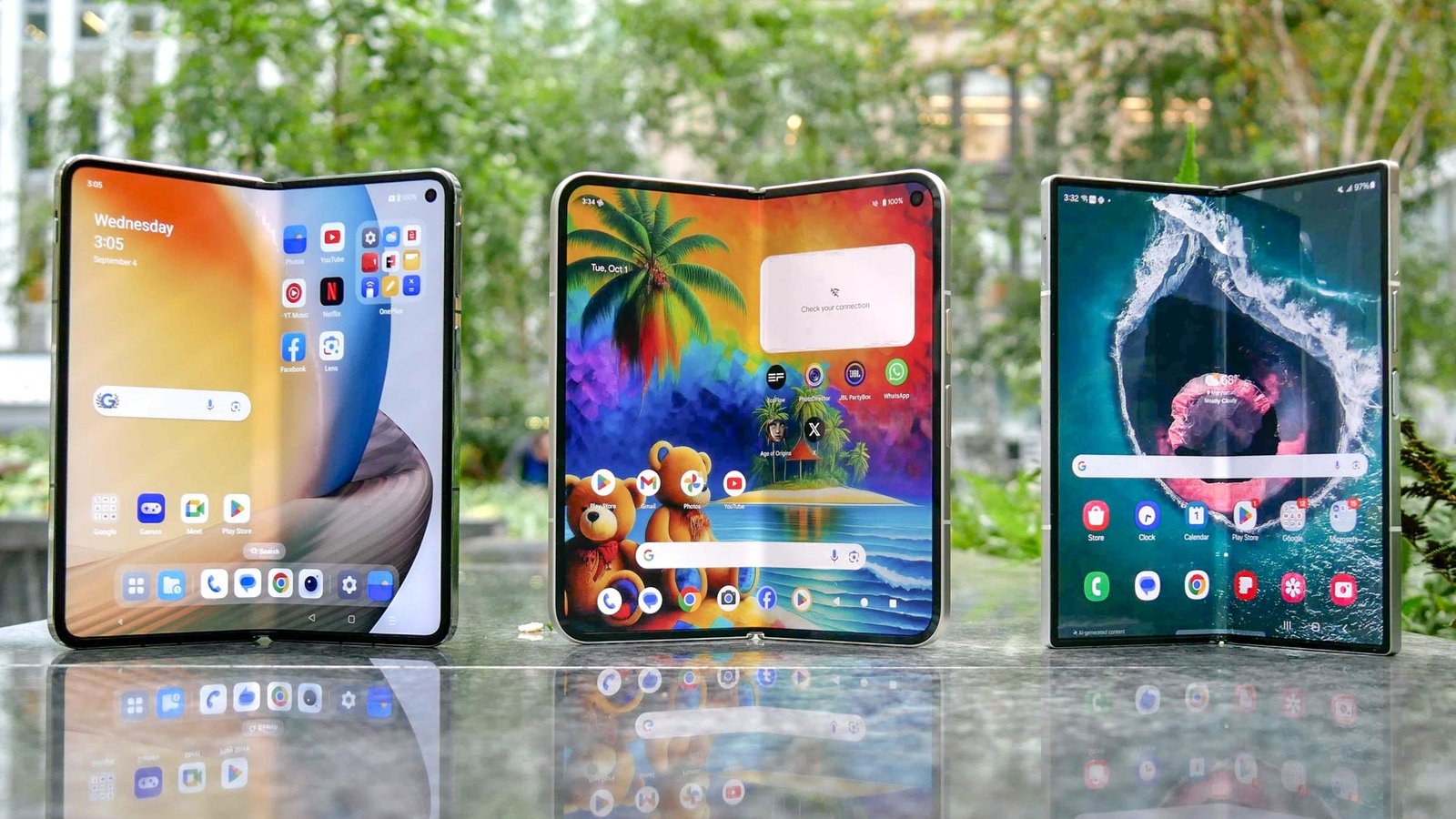
Book-style foldable phones open horizontally like a book, transforming from a standard smartphone into a small tablet. When closed, they function as regular phones using an outer display.
These devices are designed for productivity, multitasking, reading, and media consumption. They offer a large inner screen that enhances work and entertainment experiences.
Flip-Style Foldables
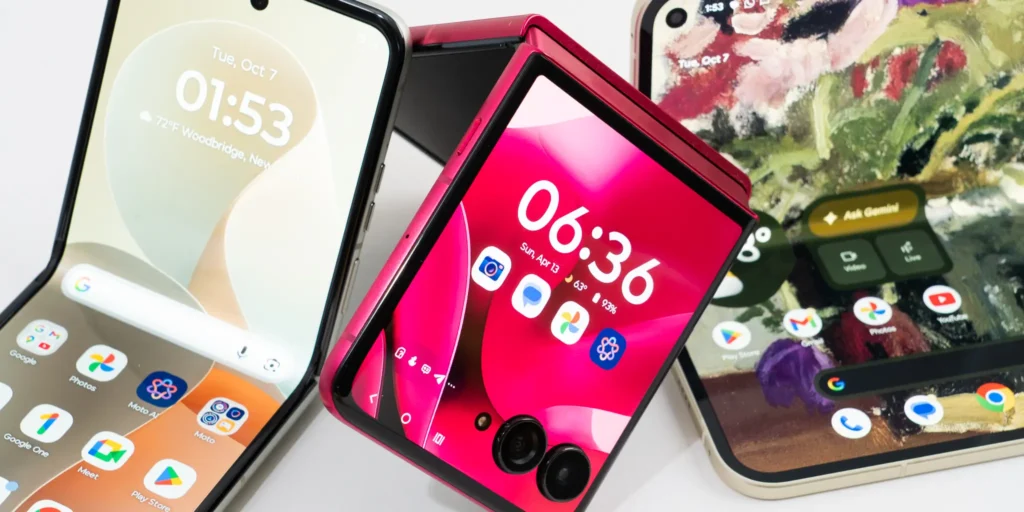
Flip-style foldable phones fold vertically, similar to classic flip phones. Their primary goal is compactness rather than screen expansion. When unfolded, they offer a normal smartphone-sized display.
These models appeal to users who want a stylish, pocket-friendly device with modern smartphone capabilities.
Design and Build Quality
Aesthetic Appeal
Foldable phones stand out visually. Their innovative form factor attracts attention and offers a premium feel. Many users appreciate the futuristic design and the novelty of unfolding a larger screen when needed.
Design improvements have made foldable phones look more refined and less experimental than earlier versions.
Thickness and Weight
Foldable phones are generally thicker and heavier than traditional smartphones due to additional components like hinges and dual displays. While this does not necessarily impact usability, it can be noticeable during extended use.
Manufacturers continue to focus on reducing thickness and weight with each generation.
Display Crease
One of the most discussed aspects of foldable phones is the visible crease along the folding line. Although modern displays have reduced crease visibility, it is still present and can be felt under certain lighting conditions or touch angles.
For many users, this becomes less noticeable over time, but it remains a consideration.
Performance and Hardware Capabilities
Processing Power
Foldable phones typically use high-end processors similar to flagship smartphones. This ensures smooth performance across demanding tasks such as gaming, multitasking, and productivity applications.
Performance is rarely a limiting factor when evaluating foldable phones.
Memory and Storage
To support multitasking and large-screen usage, foldable phones usually come with generous RAM and storage options. This allows seamless switching between apps and efficient handling of multiple windows.
Adequate memory is essential for the foldable experience to feel smooth and responsive.
Battery Capacity
Battery life is a mixed aspect of foldable phones. Larger displays consume more power, and space constraints limit battery size. Many foldable phones use dual-battery setups to distribute weight and fit within the frame.
Battery performance has improved, but heavy users may still need to charge more frequently compared to traditional smartphones.
Software Experience on Foldable Phones
Multitasking Capabilities
One of the biggest advantages of foldable phones is multitasking. Users can run multiple apps side by side, drag and drop content between windows, and use split-screen modes more effectively.
This enhances productivity and mirrors tablet-like functionality in a portable form.
App Optimization
Software optimization plays a crucial role in the foldable experience. Many popular apps now support flexible layouts that adapt to different screen sizes and orientations.
However, not all apps are fully optimized, which can occasionally result in stretched layouts or unused screen space.
Continuity Between Screens
Foldable phones are designed to maintain continuity when switching between folded and unfolded states. An app opened on the outer display seamlessly expands onto the inner screen when the device is unfolded.
This feature adds to the overall fluidity and convenience of the user experience.
Camera Performance
Camera Hardware
Foldable phones often feature high-quality camera systems comparable to flagship smartphones. Some models use the same camera sensors for both selfie and main camera functions by leveraging the foldable design.
This can result in better selfie quality and more versatile photography options.
Practical Photography Use
In real-world use, foldable phones perform well in most lighting conditions. The ability to use the main camera for selfies and video calls is a unique advantage.
However, camera performance varies by model, and some foldables prioritize design over camera innovation.
Durability and Longevity
Display Durability
While flexible displays have improved significantly, they are still more delicate than traditional glass screens. They can be more susceptible to scratches and pressure damage.
Manufacturers include protective layers, but careful handling is still recommended.
Hinge Longevity
Modern hinges are tested for thousands of folds, simulating years of regular use. While durability has improved, long-term reliability depends on usage habits and environmental factors.
Exposure to dust, sand, and moisture can affect hinge performance.
Water and Dust Resistance
Many foldable phones now offer basic water resistance, but full dust resistance remains a challenge due to the hinge mechanism. This limits their use in harsh environments.
Users must be more cautious compared to standard smartphones.
Cost Considerations
Purchase Price
Foldable phones are significantly more expensive than traditional smartphones. The advanced technology, complex engineering, and premium positioning contribute to higher prices.
For many users, cost is the primary barrier to adoption.
Repair and Maintenance Costs
Repairing a foldable phone can be costly, especially if the flexible display or hinge is damaged. Replacement parts are more expensive and less widely available.
Extended warranties and insurance plans are often recommended.
Value for Money
Whether foldable phones offer good value depends on individual usage. Users who take advantage of multitasking and large-screen features may find them worth the investment.
For basic smartphone tasks, traditional phones often provide better value.
Everyday Use Scenarios
Productivity and Work
Foldable phones excel in productivity tasks such as document editing, email management, video conferencing, and note-taking. The larger screen allows for more efficient workflows.
Professionals who rely heavily on mobile productivity may benefit the most.
Entertainment and Media Consumption
Watching videos, reading, and gaming are more immersive on foldable phones due to the expanded display. This makes them ideal for media consumption on the go.
The tablet-like experience enhances enjoyment without carrying an additional device.
Portability and Convenience
Despite their larger unfolded size, foldable phones remain portable when folded. This balance between screen size and portability is one of their key selling points.
Flip-style foldables are particularly convenient for compact storage.
Comparing Foldable Phones to Traditional Smartphones
Advantages Over Traditional Phones
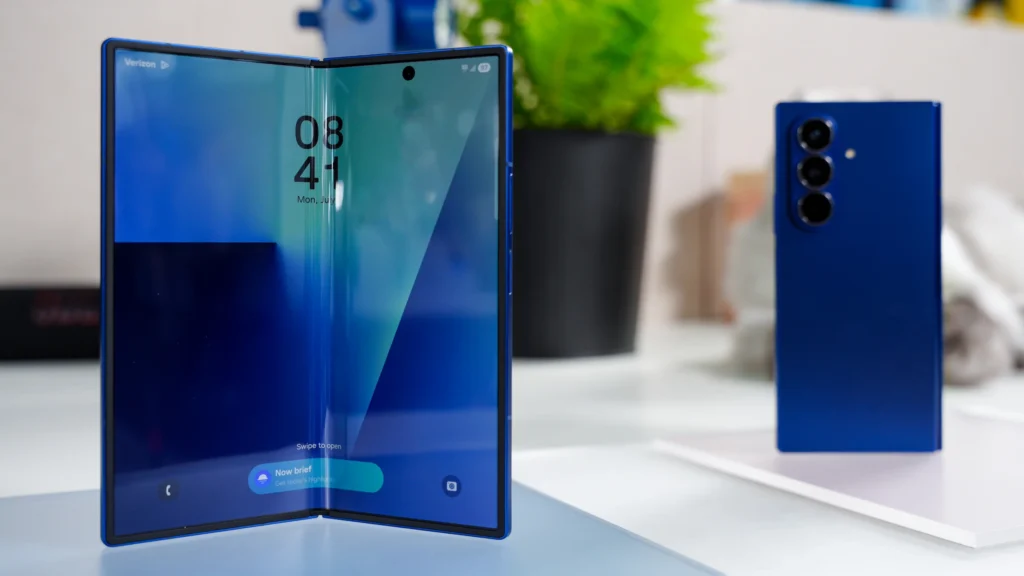
Foldable phones offer larger screens, improved multitasking, and a unique user experience. They bridge the gap between smartphones and tablets.
This versatility sets them apart from conventional designs.
Disadvantages Compared to Traditional Phones
Traditional smartphones are more durable, affordable, and straightforward. They have fewer moving parts and lower repair costs.
For users who prioritize simplicity and reliability, traditional phones remain a safer choice.
Who Should Buy a Foldable Phone
Ideal Users
Foldable phones are well-suited for technology enthusiasts, professionals, and users who value multitasking and large displays. They appeal to those willing to adapt to a new form factor.
Early adopters often enjoy exploring innovative features despite potential trade-offs.
Users Who Should Wait
Users who prioritize durability, affordability, and long battery life may want to wait for further advancements. Foldable phones are still evolving and may not meet everyone’s needs.
Budget-conscious buyers may find better options in traditional smartphones.
Future Outlook of Foldable Phones
Technological Improvements
Future foldable phones are expected to feature stronger displays, improved hinges, better battery efficiency, and enhanced software optimization.
These improvements will address many current limitations.
Market Adoption Trends
As production scales and competition increases, prices are likely to decrease. Wider adoption will encourage better app support and ecosystem growth.
Foldable phones may gradually move from niche products to mainstream options.
Long-Term Viability
Foldable phones represent a meaningful evolution in smartphone design rather than a temporary trend. Their success depends on continued innovation and consumer acceptance.
They are likely to coexist with traditional smartphones rather than completely replace them.
Final Verdict
Foldable phones have matured significantly and now offer a practical, exciting alternative to traditional smartphones. They deliver clear advantages in screen size, multitasking, and versatility, making them especially appealing to power users and professionals.
However, they still come with trade-offs, including higher costs, durability concerns, and limited dust resistance. Whether they are worth buying now depends on individual priorities, budget, and usage patterns.
For users seeking innovation and enhanced productivity, foldable phones can be a worthwhile investment. For others, waiting for further refinements or choosing a high-quality traditional smartphone may be the better decision.