

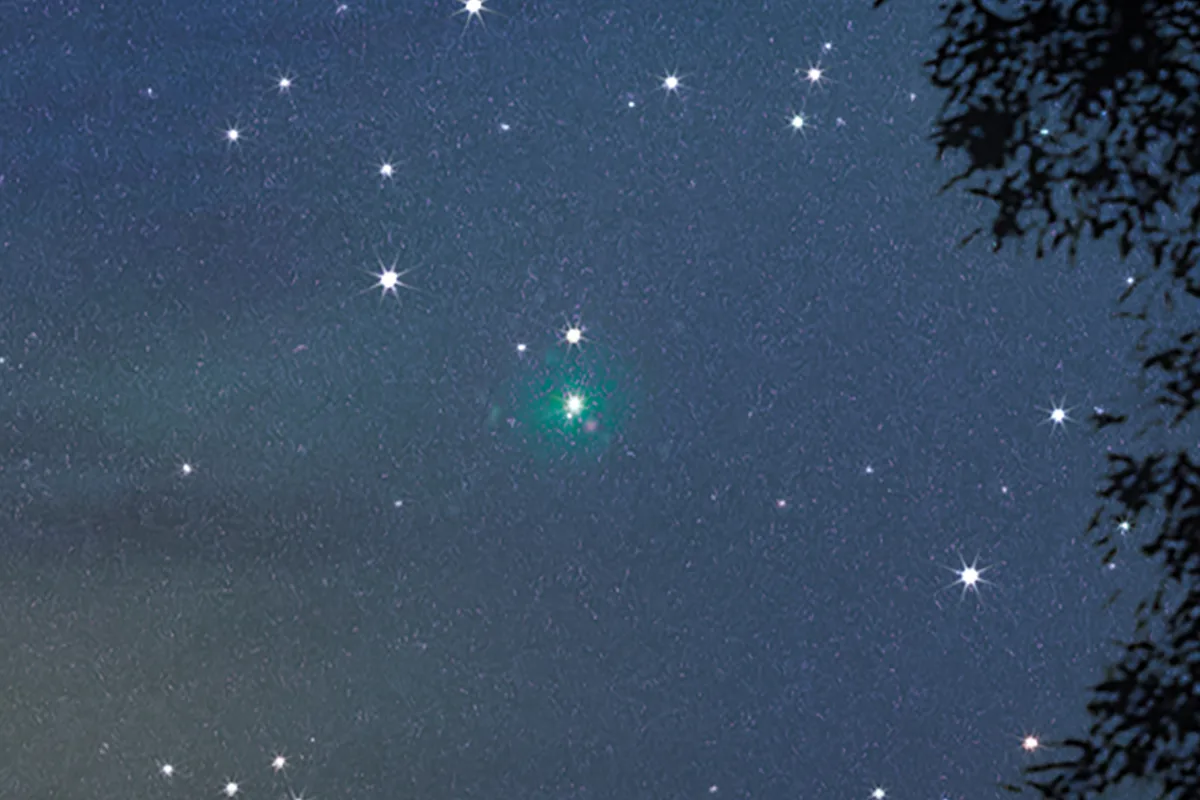
Overview Table
| Aspect | Description |
|---|---|
| Object Name | Interstellar Comet 3I/ATLAS |
| Classification | Candidate interstellar comet |
| Origin | Outside the Solar System |
| Detection Context | Wide-field sky survey observations |
| Scientific Importance | Insight into extrasolar planetary systems |
| Composition Focus | Ices, dust, and primordial material |
| Trajectory | Hyperbolic path through the Solar System |
| Observation Challenges | Speed, faintness, limited time window |
| Research Impact | Planet formation, cosmic chemistry, galactic dynamics |
| Tone of Analysis | Narrative, analytical, technical, journalistic |
Introduction: When the Solar System Is Visited, Not Observed
For most of human history, astronomy was about looking outward at distant stars and galaxies, interpreting faint light as static information. Interstellar objects changed that relationship. They are not merely observed; they arrive. Interstellar Comet 3I/ATLAS represents the idea that material from other star systems can pass directly through our cosmic neighborhood, briefly becoming part of our observational reality before vanishing back into interstellar space.
The concept of an Interstellar Comet 3I/ATLAS comet challenges long-standing assumptions. Comets were traditionally understood as relics of our own Solar System, icy bodies formed alongside the planets and preserved in distant reservoirs. An interstellar comet, by contrast, is a traveler shaped by an entirely different stellar environment. Its chemistry, structure, and history are not Solar System stories. They are galactic ones.
This article explores Interstellar Comet 3I/ATLAS as a scientific object and as a conceptual milestone. It examines how such an object is identified, what makes it different from native comets, what it may be made of, and why its brief passage matters so deeply to planetary science and astronomy.
Understanding Interstellar Objects
What Defines an Interstellar Comet
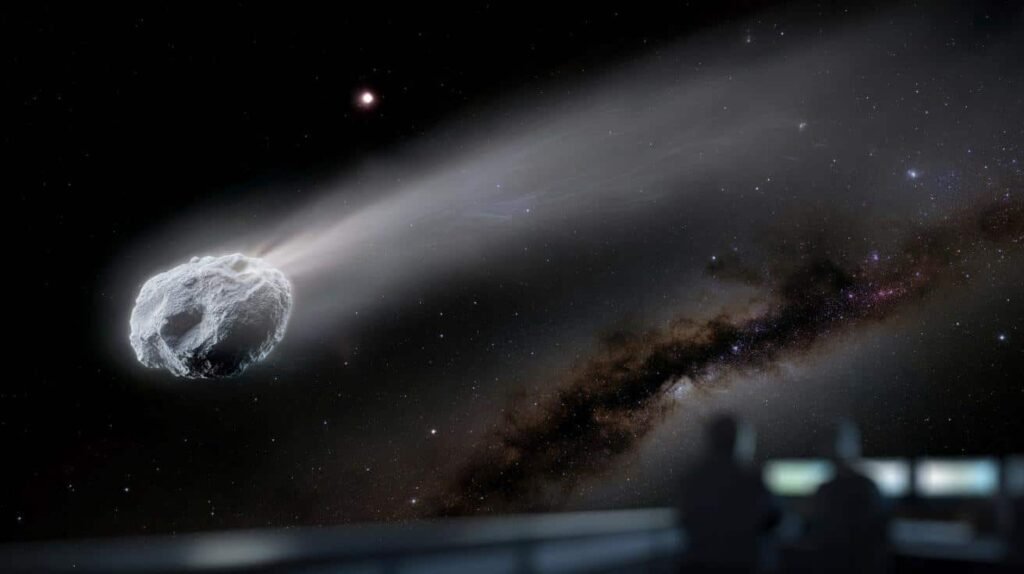
An Interstellar Comet 3I/ATLAS comet is defined primarily by its trajectory. Unlike bound objects, which follow elliptical orbits around the Sun, an interstellar comet moves on a hyperbolic path. This means it is not gravitationally tied to the Sun and will not return once it leaves.
This trajectory is the clearest indicator of an extrasolar origin. It suggests that the object formed around another star and was later ejected, likely during the chaotic early stages of planetary system formation.
Why Interstellar Comets Are Rarely Seen
Interstellar Comet 3I/ATLAS space is vast, and objects within it are small. Even though the galaxy may contain enormous numbers of rogue comets and asteroids, the probability of one passing close enough to the Sun to be detected is low.
Detection requires a combination of proximity, brightness, and timing. The object must pass within observational range and do so when survey instruments are scanning the right region of the sky.
The Role of Modern Sky Surveys
Wide-field automated surveys have transformed astronomy. They scan large portions of the sky repeatedly, detecting moving objects and transient events. Without such systems, interstellar objects like Interstellar Comet 3I/ATLAS would likely pass unnoticed.
These surveys are not designed specifically to find interstellar visitors. They are built to monitor near-Earth objects, variable stars, and other phenomena. Interstellar discoveries are a byproduct of their breadth and sensitivity.
The Discovery Context of 3I/ATLAS
Detection as an Anomaly
Interstellar Comet 3I/ATLAS would have first appeared as an ordinary moving point of light. Only after repeated observations could its unusual motion be recognized. Its speed and trajectory would not align with typical Solar System dynamics.
Such recognition is a process, not a moment. Astronomers refine orbital calculations as new data arrives. The realization that an object is Interstellar Comet 3I/ATLAS emerges gradually, as the hyperbolic nature of its path becomes undeniable.
Naming and Classification
The designation “3I” indicates its status as the third recognized interstellar object. The “ATLAS” component reflects the survey system responsible for its detection.
This naming convention is more than administrative. It reflects a shift in astronomical thinking, acknowledging that interstellar visitors are a distinct and meaningful category of object.
Public and Scientific Reaction
Interstellar Comet 3I/ATLAS objects capture attention beyond the scientific community. They resonate with a broader audience because they feel tangible, like messengers from other worlds.
Within science, however, the reaction is measured. The focus is on data quality, observational opportunities, and what can realistically be learned before the object departs.
Physical Characteristics of Interstellar Comet 3I/ATLAS
Size and Structure
Estimating the size of an Interstellar Comet 3I/ATLAS comet is difficult. Observations are influenced by brightness, distance, and activity. If 3I/ATLAS displays a coma and tail, these features can obscure the nucleus itself.
The nucleus is likely small by planetary standards, perhaps only hundreds of meters or a few kilometers across. Yet within that small body lies material formed around another star.
Activity and Outgassing
As an Interstellar Comet 3I/ATLAS comet approaches the Sun, solar heating can trigger the sublimation of volatile ices. Gas and dust escape the nucleus, forming a coma and tail.
The composition of these volatiles is of particular interest. Differences from Solar System comets could reveal variations in chemical environments across the galaxy.
Rotation and Shape
Changes in brightness over time can indicate rotation. An irregular shape, common among small bodies, would produce periodic variations as different surface areas reflect sunlight.
Rotation also affects activity. Jets of gas can act like thrusters, subtly altering the object’s motion.
Composition: A Chemical Message From Another Star
Ices Beyond the Familiar
Solar System comets contain water ice, carbon dioxide, carbon monoxide, and a range of organic compounds. An Interstellar Comet 3I/ATLAS comet may share some of these components, but relative abundances could differ significantly.
Such differences would reflect the temperature, radiation environment, and elemental composition of its birth system.
Dust and Minerals
Dust grains released from the comet carry information about solid material formation. Grain size, structure, and composition are clues to the processes that shaped the protoplanetary disk of another star.
Even limited spectral data can hint at these properties.
Organic Chemistry and Prebiotic Implications
Comets are often discussed in the context of organic chemistry and the origins of life. An interstellar comet extends this discussion beyond the Solar System.
If complex organic molecules are present, they suggest that the building blocks of life may be widespread in the galaxy, forming naturally in diverse environments.
Orbital Dynamics and Trajectory
Hyperbolic Motion Explained
A hyperbolic orbit means the object has more than enough energy to escape the Sun’s gravity. It approaches, swings past, and departs without completing a closed loop.
This motion distinguishes interstellar objects from those merely perturbed into elongated Solar System orbits.
Speed and Direction
Interstellar Comet 3I/ATLAS objects often move faster than typical comets. Their velocity reflects both their original motion through the galaxy and the gravitational acceleration they experience near the Sun.
The incoming direction can offer hints about their galactic origin, though uncertainties are large.
Gravitational Interactions
As 3I/ATLAS passes through the Solar System, it may experience minor gravitational influences from planets. These interactions slightly alter its trajectory but do not capture it.
The object remains a transient visitor.
Observational Challenges
Limited Time Window
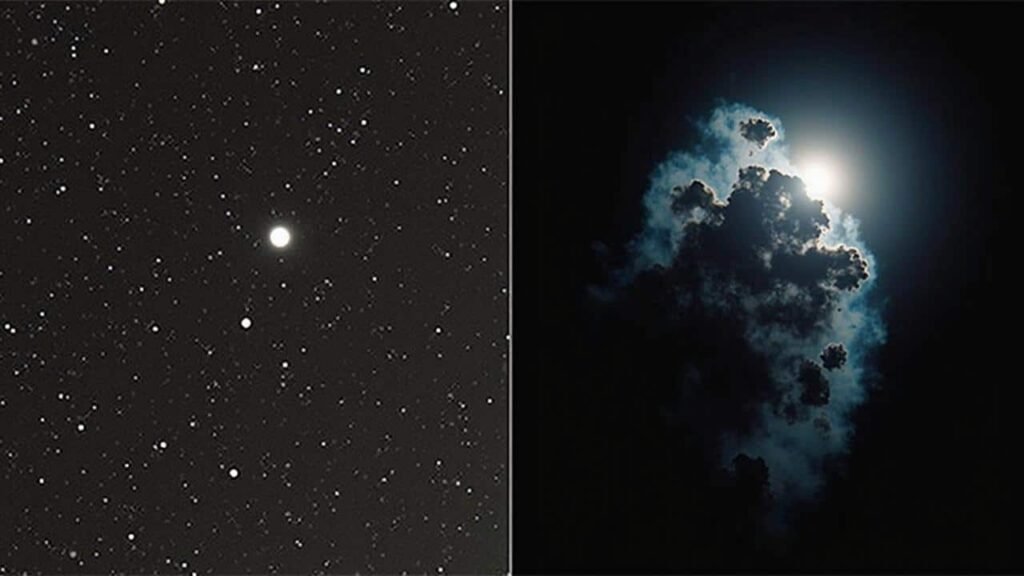
Interstellar Comet 3I/ATLAS objects do not linger. Their high speeds and unbound orbits mean observational opportunities are brief.
Astronomers must prioritize measurements quickly, often coordinating globally to maximize data collection.
Distance and Faintness
By the time an Interstellar Comet 3I/ATLAS comet is identified, it may already be receding or still far from the Sun. Its faintness limits the resolution and detail achievable.
Every observation is a balance between exposure time and motion blur.
Instrumentation Limits
Even the most advanced telescopes have constraints. Spectroscopy, imaging, and photometry all compete for limited observation time.
Interstellar Comet 3I/ATLAS comets force astronomers to make strategic choices about what data matters most.
Scientific Significance of 3I/ATLAS
Testing Planet Formation Theories
Planetary systems are believed to eject large numbers of small bodies during formation. Interstellar comets are the surviving evidence of this process.
Studying 3I/ATLAS helps test models of how common such ejections are and how similar or different planetary systems may be.
Comparing Extrasolar and Solar Material
Every interstellar object provides a comparison point. Similarities suggest universal processes; differences highlight diversity.
This comparative approach is essential for understanding our own Solar System in context.
Expanding the Scope of Planetary Science
Traditionally, planetary science focused inward. Interstellar objects blur the boundary between planetary science and galactic astronomy.
They are small bodies with large implications.
Cultural and Philosophical Dimensions
A Visitor Narrative
There is a natural tendency to anthropomorphize interstellar objects as visitors or messengers. This narrative reflects a deep human desire to connect with the broader universe.
While scientifically neutral, this framing influences public engagement and curiosity.
Shifting Cosmic Perspective
Interstellar comets remind us that the Solar System is not isolated. Material moves between stars, carrying physical evidence of distant processes.
This perspective reshapes how humanity views its place in the galaxy.
Inspiration for Future Exploration
The fleeting nature of interstellar visitors has inspired discussions about rapid-response missions. While technically challenging, the idea of intercepting such an object captures imagination.
3I/ATLAS contributes to that long-term vision.
The Future of Interstellar Object Research
Improved Detection Rates
As surveys become more sensitive, detections of interstellar objects are expected to increase. What seems rare today may become routine tomorrow.
Each new detection will refine statistical understanding.
Better Characterization Techniques
Advances in spectroscopy, imaging, and data analysis will allow more detailed studies within short time frames.
Automation and artificial intelligence may play a growing role.
From Curiosity to Category
Interstellar objects are transitioning from anomalies to a recognized population. This shift changes how research programs are designed and funded.
3I/ATLAS stands as part of this transition.
Conclusion: A Small Object With Galactic Meaning
Interstellar Comet 3I/ATLAS is, in physical terms, a modest body. It is not large, not bright, and not long-lasting. Yet its significance is disproportionate to its size.
It represents direct physical evidence that planetary systems exchange material across the galaxy. It carries within it a chemical and structural record of a distant stellar environment. Its brief passage challenges astronomers to learn as much as possible in a limited time.
More broadly, 3I/ATLAS symbolizes a shift in astronomy from passive observation to active encounter. The universe is not only something we look at. Occasionally, it comes to us.